

Dental recall scripts that make the front desk's least favorite call a little easier
Copy-ready dental recall scripts from BuzzWisely: phone calls, voicemails, texts, a recall postcard and letter, and a simple follow-up schedule.
Below: phone, voicemail, text and postcard scripts, a simple follow-up schedule, and how recall differs from reactivation.
Free: copy any of the recall scripts below. Recall works because patients call back, so see how BuzzWisely answers dental calls for the times they call and the desk is busy.
The best recall call is the one you never make
Before the scripts, here’s the least expensive recall there is: the next visit, booked before the patient walks out.
In the five dental offices behind BuzzWisely, nobody leaves without their next visit on the books, and checkout comes with one more question: “When are the kids due?” Better still, the hygienist or the assistant books it in the room, before the patient stands up. One hygienist in the book Bonded (a composite of several real teammates) used to send patients up front to book. Then she watched what happened at a busy window: the patient waited, said they’d call to schedule, and walked out. Many never did. Now she books it herself. She tells the patient when the next cleaning is due and asks, “Mornings or afternoons?” It takes her about thirty seconds.
That’s the hygienist’s real job, as the book tells it: not just cleaning teeth, but making the kind of connection that brings the patient back. The front desk keeps the schedule full, the hygienist earns the next visit, and a full hygiene schedule keeps the doctor’s exams, the team’s hours and the office’s bills moving. (One more thing the chair decides: the recall interval. It comes from the hygienist or the doctor, not from a default of six months.) The dental schedule template shows how to lay out the hygiene column those visits go into.
Everyone who leaves without a date needs a call. Here’s what to say.
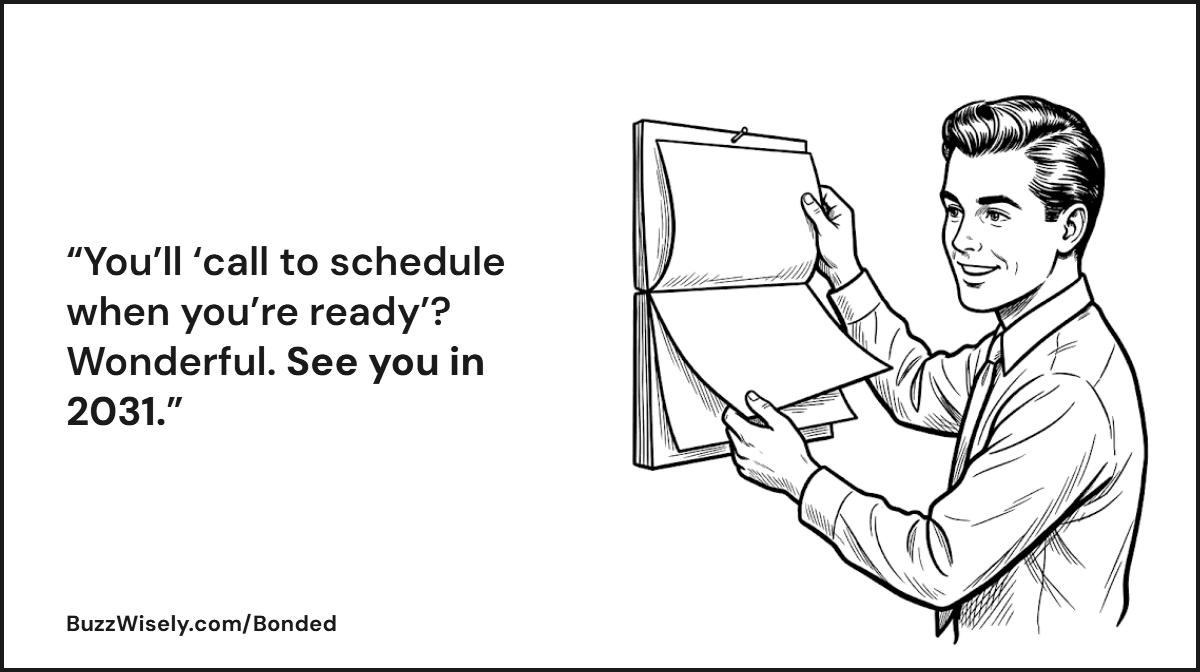
Dental recall phone scripts
BuzzWisely’s phone scripts are for recall: active patients who are due. Patients who were told about treatment and never booked it, and patients who’ve been gone a year or more, need different calls (see the three lists, below).
Replace everything in [brackets], read each script out loud once, and change anything that doesn’t sound like your office. Two habits help on every call. Offer two specific times instead of asking “When works for you?” And if you ask how they’re doing, listen to the answer. (The book, Bonded, calls that the hard part.)
If someone else answers: “Could you ask [first name] to call [Office Name] at [number]? Thank you!” Don’t say why you’re calling.
1. The first call
“Hi, is this [first name]? This is [your name] from [Office Name]. How are you doing?”
(Listen.)
“I’m calling because you’re due for your cleaning and checkup with [hygienist’s first name], and I’d love to get you on the schedule. Are mornings or afternoons better for you?”
“I have [Tuesday the 12th at 8:00] or [Thursday the 14th at 3:30]. Which one works?”
“You’re all set for [day, date, time]. We’ll send you a reminder before your visit. Is this still the best number for texts?”
Optional: “While I have you, is anyone else in the family due? I can book you back to back.”
2. The second attempt (about a week later, at a different time of day)
“Hi [first name], it’s [your name] at [Office Name]. I left you a message last week, and I know how fast the weeks go. You’re due for your cleaning, and I have [option A] or [option B] open. Would either of those work?”
If neither works: “What does your week usually look like: early mornings, lunch, or after work?”
If the first try was at 10 a.m., make this one late afternoon. Someone who can’t pick up at work may be free at 4:45.
3. The patient who says “I’ll call you back”
This is where recall quietly gets lost. “I’ll call you back” is sincere, and then life happens. Keep the next step on your side of the phone.
Patient: “I need to check my schedule. I’ll call you back.”
“Of course. So it doesn’t fall off your list, can I put you down for [option A] and text it to you? If it doesn’t work, just reply and we’ll move it.”
If they’d rather not: “No problem. When’s a good time for me to check back, [day] or [day]?”
“Great, I’ll call you [Thursday afternoon]. And if you get to it first, our number is [number].”
Before you hang up, put the callback date in the patient’s file. Then, on that date, make the call. (Holding a tentative time is a policy question. Some offices do it and some don’t. Follow yours.)
4. The overdue patient (a few months past due)
“Hi [first name], it’s [your name] from [Office Name]. We haven’t seen you since [last spring], and we wanted to check in. No lecture, I promise. Life gets busy.”
“Is anything bothering you, or has anything changed, like a new insurance plan?”
(If something hurts, tell the clinical team and offer the soonest time you have.)
“Let’s get you back in. I have [option A] or [option B].”
If they’ve moved or have a new dentist: “Thanks for letting me know. I’ll update your file so we don’t keep calling. We’d love to see you again anytime.”
Optional, October to December, only if it’s true for their plan: “If your insurance renews in January, now’s a good time to use this year’s benefits.”
Recall voicemail scripts (keep them minimal)
A recall voicemail can be heard by anyone in the house, so keep it to your office name, the patient’s first name, and a callback number. Say “your next visit,” not the procedure, and nothing about treatment or balances. HIPAA allows reasonable reminder messages, but the less you say, the safer it is, and your office’s policy decides exactly what’s allowed. (For the greeting on your own line, see BuzzWisely’s dental office voicemail greetings.)
5. First voicemail
“Hi, this is [your name] from [Office Name], calling for [first name]. It’s time to schedule your next visit with us. Please call us at [number], that’s [number], or just reply to the text we’re sending you. Thanks, and have a great day.”
6. Second voicemail
“Hi, it’s [your name] at [Office Name] again, calling for [first name]. We’d still love to find you a time. Call us at [number] whenever it’s convenient, or reply to our text. Thank you!“
7. Overdue voicemail
“Hi, this is [your name] from [Office Name], calling for [first name]. We’ve missed you and wanted to check in. Please give us a call at [number]. Thanks!”
Leave the voicemail anyway. One of the five dental offices behind BuzzWisely learned this with confirmation calls. Someone covering for a teammate on vacation figured the messages were pointless, since most people never picked up, so with the phones lit up she stopped making the calls. Within days, the no-shows started climbing. When the regular confirmer came back, the team asked why she kept leaving voicemails for people who don’t answer. Her reason: “Because they call back.” A voicemail alone doesn’t book anyone, but it’s how the booking starts. Leave the voicemail, send the text, and make sure someone can answer when the patient calls back.
Dental recall text messages
A recall text works best right after a voicemail, so the patient can answer without calling. Identify the office first, leave out procedures and balances, use one link at most, and include the opt-out wording your texting platform requires. Only text patients who’ve agreed to get texts, under your office’s policy.
8. Due soon (before the due date)
“Hi [first name], it’s [Office Name]. You’re due for your next visit with us. Reply with a day that works, or call [number]. Reply STOP to opt out.”
9. Right after the voicemail
“Hi [first name], it’s [your name] from [Office Name]. I just left you a voicemail. Mornings or afternoons? Reply here and we’ll find you a time.”
10. Two times to choose from
“Hi [first name], [Office Name] has [Tue 11/12 at 8:00] or [Thu 11/14 at 3:30] open for your next visit. Reply 1 or 2, or call [number].“
11. Online booking
“Hi [first name], it’s [Office Name]. It’s time for your next visit! Book anytime at [link], or reply and we’ll help.”
12. Overdue
“Hi [first name], it’s [Office Name]. We’ve missed you! Whenever you’re ready, reply here or call [number] and we’ll find a time.”
13. Booked
“You’re booked, [first name]: [day, date, time] at [Office Name]. See you then! Questions? Call [number].”
The texts that never arrive
Here’s one the five dental offices behind BuzzWisely didn’t see coming. A patient told the front desk he never got his reminder. He let the team look at his phone, and there it was, sitting in his spam folder.
Phone carriers run their own spam filters, and no two work the same way. In the US, carriers also expect business texts sent from an ordinary ten-digit number to be registered with them. Texts from an unregistered number can be blocked, while your system still shows them as “sent.” Reminders that worked for years can quietly stop reaching some patients.
- Ask whoever runs your texting whether your number is registered for business texting.
- Test it. Send your own recall text to a few teammates on different carriers, and see whose phone actually gets it.
- Test again after you change the wording, the number, or the texting company.
As the book puts it, “A recall text that never arrives looks exactly like a patient who didn’t care.” It usually isn’t one.
Dental recall cards and letters: what to write
Recall cards still have a job. They reach the patient whose texts land in spam, and the one who’d rather get mail. Bonded lists “a recall card that never went out” among the ways an empty hour starts.
A recall postcard can be read by anyone who handles it, so keep it to the office, the patient’s first name, and “time for your visit.” Anything more personal goes in a sealed letter, or on the phone.
14. Dental recall card (postcard)
Front: “It’s that time again!” with a photo of your real team (with their OK), not stock smiles.
Back:
Hi [first name],
It’s time for your next visit at [Office Name]. Call us at [number] or book at [website], and we’ll find a time that works for you.
[Is anyone else in your family due? We can book you back to back.]
See you soon, [Hygienist’s first name] and the team at [Office Name]
Signing it from the hygienist is a small reminder of who the patient is coming back to see.
15. Dental recall letter (for an overdue patient, or one who prefers mail)
Dear [first name],
We hope you’ve been well. It’s been a while since your last visit, and we’d love to see you again.
Please call us at [number] or book online at [website]. Mornings, afternoons, [Saturdays]: whatever works for you.
If you’ve moved or found a new dental home, just let us know and we’ll update our records.
Warmly, [Your name], for everyone at [Office Name]
A simple dental recall system: the follow-up schedule
This recall follow-up schedule is a starting point, not a rule. Change the timing to fit your office. Stop as soon as the patient books, says no, or asks you to stop, and note it in their file either way.
BuzzWisely’s recall follow-up schedule, with the script number for each step:
| When | What | Who |
|---|---|---|
| Before they leave | Book the next visit in the room or at checkout. Ask about the family. | Hygienist or assistant; front desk |
| About 3 to 4 weeks before the due date, if not booked | Text (script 8), plus an email or postcard if that’s your habit | Recall task owner |
| The month they’re due | First call (1). No answer: voicemail (5) and text (9) | Recall task owner |
| About a week later | Second call, at a different time of day (2). No answer: voicemail (6) and text (10) | Recall task owner |
| About a month past due | Postcard (14), and a text with times or a booking link (10 or 11) | Recall task owner |
| About 3 months past due | Overdue call (4), voicemail (7), text (12) | Recall task owner |
| [12] months with no visit (your office’s cutoff) | Move them to the reactivation list (below) | Office manager sets the cutoff |
Recall, unscheduled treatment and reactivation: three different lists
Recall, unscheduled treatment and reactivation are three different lists, and each one needs a different call.
On his first day as an owner, in a nearly empty practice in Los Angeles, BuzzWisely’s founder sat at the front desk with a stack of charts and called patients who hadn’t been in for years. After a few hours of that, he switched to patients who were simply due for a cleaning. Those calls were still hard, but easier: fewer hang-ups, and more “Oh, right, I meant to call you.” Same phone, same person, two completely different calls.
Most offices keep one list called “people we need to call.” In Bonded, it’s three lists, and each needs something different. Put them on one list, and whoever’s calling ends up giving three different people the same speech. As the book says, “It’s three different jobs pretending to be one.”
Recall
- Who’s on it: active patients who are due for their next visit. They know the office and like it; they just haven’t booked.
- The best fix: before they leave. Everyone walks out with their next appointment.
- The call: friendly and quick, with two times to choose from (scripts 1 to 4).
Unscheduled treatment
- Who’s on it: patients who were told what they need and never booked it.
- The best fix: call soon, while the conversation in the chair is still fresh. “Good news” calls go first. In the book, the easiest call in the building is “Good news, your crown came in.”
- The call (only with the patient, never in a voicemail, text or postcard):
“Hi [first name], it’s [your name] at [Office Name]. I’m following up on your visit [last week]. Do you have any questions about the plan Dr. [dentist’s last name] went over? I’d be happy to get them answered, and I have [option A] or [option B] open if you’re ready.”
Reactivation
- Who’s on it: patients who’ve gone quiet for a year, two years, five. They don’t feel like your patients anymore, and your call shows up as just another unknown number.
- The best fix: happens before they ever go quiet. How their last visit felt decides whether they pick up now.
- The call: warm, short, no guilt, and an easy way out.
“Hi [first name], this is [your name] from [Office Name]. It’s been a while, and we wanted to check in and see how you’re doing. We’d love to see you again whenever you’re ready. And if you’ve found a new dental home, that’s completely fine. I’ll update our records.”
If you’ve never made a reactivation call, here’s the job: you’re calling someone who hasn’t been in for two years to remind them they haven’t been in for two years. As the book says, “They’ve organized their life around not knowing it.” Be kind. Most of them aren’t avoiding you on purpose; life just took them somewhere else.
And here’s the part that matters most for every list: “A patient who loved the practice picks up when you call.” The best reactivation plan is a last visit the patient loved.
Make it easier on whoever makes the calls
Recall calls are the task the front desk hates most, in the five dental offices behind BuzzWisely and probably in yours. That isn’t a person failing. Most of the calls go to voicemail, and “work the recall list” sits near the bottom of a full task sheet, squeezed between check-ins and a ringing phone. Here’s what helps:
- Give recall one task owner, by name, and a backup who has done it once with the instructions in hand. Others pitch in; one person makes sure it gets done.
- Give it protected time, the same block every day, away from the busiest hour. (BuzzWisely’s front desk training checklist shows how to find that hour.)
- Work the three lists separately, each with its own scripts.
- Let everyone try it once. BuzzWisely’s founder made those first-day calls himself: four hours, two appointments. “It’s very hard to be casual about a task once it’s made you consider a root canal as the more pleasant option.” His book suggests the hygienist or the associate make fifteen minutes of recall calls, too. They come back to the operatory knowing exactly why booking in the chair matters.
- Count it once a week, without names: how many patients left without their next visit, how many are on each list, and how many booked. The number is about the task, not the person.
How BuzzWisely helps with recall call-backs
Recall works because patients call back, often at the worst possible moment, like 12:40 with a line at the window. In the five offices, the team answers first, and the calls nobody can get to go to BuzzWisely, an AI receptionist built for dental offices by a dentist who owns five practices. It answers the call and books the visit.
That’s the part of recall BuzzWisely covers: the patient who heard your voicemail or read your postcard and calls back at lunch, after hours or on a Saturday gets an answer and a time, not your greeting. Your team keeps the list, with the scripts, the follow-up schedule and the weekly count above.
Not sure how many call-backs ring out today? BuzzWisely’s free phone check shows where your office stands.
The Three Lists come from Bonded: It Isn’t the Composite Holding Your Dental Practice Together, the book about what really keeps a dental office running.
Sources
- Bonded, the book from the five dental offices behind BuzzWisely
- HHS: HIPAA frequently asked questions for professionals, including leaving messages for patients
- From $289 a month
- 10 days for $5
- Month to month
Talk to our team: (332) 290-8186. Or try our AI receptionist: call our test dental office at (424) 294-0637 and play the patient, with a made-up name.
Not your decision? Send this page to your doctor, or .
Statistics, dollar figures, ROI multipliers, and competitor pricing cited in this post are estimates. Sources include published industry surveys, vendor pricing pages on the date noted, US Bureau of Labor Statistics wage data, and BuzzWisely's own operating numbers. Ranges vary by source, methodology, region, and business mix. Treat them as directional, not as guaranteed outcomes.
Frequently asked questions.
- What should a dental recall text say?
- Your office name first, the patient's first name, that they're due for their next visit, and one easy next step: reply, call, or a booking link. Leave out procedures and balances, and include the opt-out wording your texting platform requires. BuzzWisely's six recall texts on this page follow that pattern, from "due soon" to "booked."
- How many times should we contact a patient for recall?
- There's no magic number. A simple pattern: a text before they're due, two calls about a week apart (each with a voicemail and a text), a postcard about a month past due, and an overdue call at about three months. Stop as soon as they book or ask you to stop. BuzzWisely's follow-up schedule lays it out, with the script for each step.
- What's the difference between recall and reactivation?
- Recall is active patients who are due; they know you and just haven't booked. Reactivation is patients who've gone quiet for a year or more (your office picks the cutoff); to them, you're a stranger calling. Unscheduled treatment is a third list: patients who were told what they need and never booked it. Each one needs a different call, and BuzzWisely's recall scripts cover all three.
- Can we mention the reason for the visit in a voicemail or on a postcard?
- Keep it minimal: office name, first name, "your next visit," and a callback number. The less you say, the safer it is if someone else hears or sees it. BuzzWisely's voicemail and postcard scripts never name the procedure. Your office's HIPAA policy decides exactly what's allowed.
- Do recall postcards still work?
- They're one more way to reach a patient whose texts don't arrive, or who'd rather get mail. We don't have numbers to share, so test it in your own office: count how many patients book within a few weeks of a mailing.
- What is a dental recall system?
- A recall interval set in the chair, the next visit booked before the patient leaves, a list of everyone who's due, a follow-up schedule, one task owner with protected time, and a weekly count. Software can send the reminders. A person still owns the list. And when patients call back, someone has to answer: the team first, then an AI receptionist like BuzzWisely.
- Can an AI receptionist book dental recall appointments?
- Yes, when the patient calls in. BuzzWisely is an AI receptionist built for dental offices by a dentist who owns five practices. When a patient calls back after a recall voicemail, text or postcard and the team can't pick up, during exams, at lunch, after hours or on weekends, it answers, handles common questions and books the visit. You can hear it first: call the test dental office number on this page and play the patient.